Warehouse exterior cleaning is more involved than renting a pressure washer and spraying down a dirty wall. Facility size, surface materials, chemical exposure, worker safety, and runoff all affect how the job should be planned.
This guide compares professional and DIY cleaning across equipment, safety, environmental considerations, time, and cost. The goal is to help facility managers determine which approach fits the size and cleaning requirements of their warehouse.
Quick Comparison: Professional Warehouse Cleaning vs. DIY
Quick Answer: Professional crews bring compliant equipment and disposal practices for warehouse exterior cleaning. DIY rental units skip both, leaving the compliance gap for you to fill.
Side-by-Side Criteria
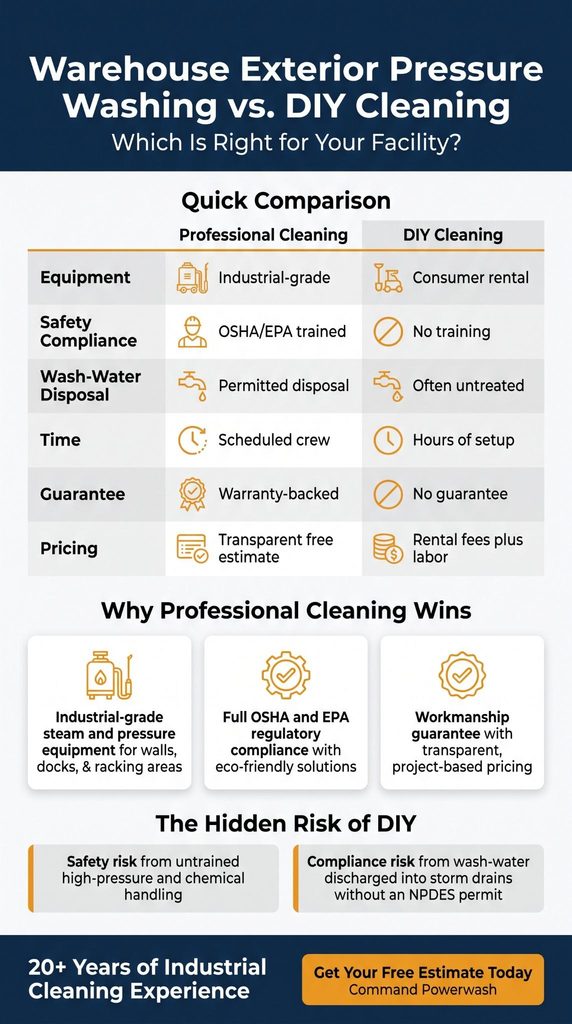
| Factor | Command Powerwash | DIY Rental |
| Equipment capability | Industrial-grade pressure and steam cleaning | Consumer or mid-tier rental units |
| Safety compliance | OSHA- and EPA-compliant crews | No formal safety training required |
| Wash-water disposal | Managed per discharge regulations | Often discharged untreated |
| Time investment | Scheduled, completed by a trained crew | Hours of setup, trial, and cleanup |
| Guarantee | Warranty-backed results | No guarantee on outcome |
| Pricing | Transparent, project-based, free estimate | Rental fees plus your own labor hours |
Every row on this table points to the same question. Who is responsible if something goes wrong? That answer shapes the rest of this comparison.
The U.S. Environmental Protection Agency lists public warehousing and storage among the facility types subject to federal stormwater rules, which is one reason the disposal row above matters more than it first appears.
What Command Powerwash Does Best
Quick Answer: Command Powerwash pairs industrial-grade equipment with documented safety and environmental compliance for warehouse exterior cleaning, backed by a workmanship guarantee.
Industrial-Grade Equipment Built for Warehouse Surfaces
Warehouse exteriors carry grease, dirt, mildew, and chemical buildup that consumer-grade equipment struggles to remove safely. Command Powerwash uses industrial-grade cleaning agents combined with high-pressure and steam cleaning, covering exterior walls, loading docks, and racking or storage areas.
Crews check the surface material and contamination type before selecting pressure and chemical settings, since the wrong combination on painted metal panels or aging brick can cause more damage than the buildup itself.
That surface assessment step is what separates a proper warehouse exterior cleaning job from a quick rinse.
Full Safety and Environmental Compliance
Safety and environmental compliance sit at the center of every job. Command Powerwash operates fully compliant with the latest safety, OSHA, and EPA regulations.
Wash-water handling and chemical use follow the same standards inspectors expect to see on an industrial site, including the labeling and hazard training duties set out in OSHA’s Hazard Communication Standard.
Crews also use eco-friendly, biodegradable cleaning solutions. This reduces the risk of harsh runoff reaching nearby drains or landscaping during a large-scale job. That compliance record shows up in the results clients describe.
“I reached out to these guys for our annual cleaning, and they did an outstanding job! On time, very professional, and just overall excellent service. I highly recommend asking for Richard or Dan!” says Kathy O, a Command Powerwash client.
Guaranteed Results With Transparent Pricing
Every warehouse cleaning job is backed by a workmanship guarantee and transparent, project-based pricing with no hidden fees. You get a free, no-obligation estimate before any work starts.
Budget approval never depends on guesswork or a surprise invoice after the job is done. Scheduling works around your operating hours, either online or by phone, which matters for a facility that cannot afford a full shutdown mid-shift.
With more than 20 years in business and over 50 years of combined team experience, the crew has already handled the surface types and contamination patterns most warehouse managers only encounter once in a facility’s lifetime.
What DIY Cleaning Offers
Quick Answer: DIY cleaning suits small, low-risk warehouse exterior cleaning tasks, not full-scale industrial jobs.
When DIY Makes Sense
DIY pressure washing works for small, low-risk jobs, such as spot-cleaning a loading zone or removing light dust from a side entrance.
Rental units give you access to pressure washing equipment without buying it outright. The upfront rental cost is usually lower than hiring a crew for a single small task. Most rental counters walk you through basic operation in a few minutes.
The trade-off is that rental units rarely match industrial-grade steam and pressure output. You become responsible for handling chemicals, wash-water runoff, and equipment setup and teardown yourself, with no guarantee on the finished result.
The Key Differences That Matter
Quick Answer: The real gap between DIY and professional warehouse exterior cleaning is not price. Responsibility for safety and compliance risk is what actually shifts once the job is underway.
Safety and Chemical Handling
Yes, a rental unit gives you the same pressure-washing tool a professional crew uses. Access to equipment is not the same as training to use it safely.
Untrained handling of high-pressure water and degreasing chemicals can increase workplace injury risks. The Occupational Safety and Health Administration incident records include pressure-washing injuries, including high-pressure injection injuries and chemical exposure incidents.
The Centers for Disease Control and Prevention also tracks acute inhalation injuries tied to chemical exposure in the workplace, a risk that rises when degreasing agents are mixed or applied without training.
Broader labor data from the U.S. Bureau of Labor Statistics shows that contact with equipment remains a leading cause of nonfatal workplace injury nationwide, which includes pressure-washing tools used without proper handling.
Regulatory and Environmental Compliance Exposure
Warehouse washwater can create compliance risks when it enters storm drains. Under the Clean Water Act, industrial facilities may need NPDES permit coverage for stormwater discharges, as outlined by the EPA and Alabama Department of Environmental Management.
ADEM also lists Form 2F for industrial stormwater discharge applications.
Hosing grease or chemical residue into a storm drain can expose the facility to violations. Professional crews use proper containment and disposal practices to help keep that responsibility off your team.
Which Option Is Best for You?
Quick Answer: The right choice for warehouse exterior cleaning depends on scale, risk, and who carries the compliance burden.
Best Fit for Each Option
DIY cleaning best fits facility staff handling a small, low-risk spot clean with no wash-water discharge concerns, such as wiping down a single entryway between scheduled services.
Command Powerwash best fits Birmingham-area warehouse and industrial facility managers who need OSHA and EPA-compliant, guaranteed exterior cleaning without taking on personal liability for a compliance mistake or a damaged surface.
Frequently Asked Questions
Quick Answer: These answers cover the most common questions facility managers ask before booking warehouse exterior cleaning.
Q1. Is professional warehouse exterior pressure washing worth the cost compared to DIY?
Professional cleaning costs more upfront than a rental unit, but it includes trained labor, industrial-grade equipment, compliant wash-water handling, and a workmanship guarantee.
For a facility with regular grease, chemical, or dirt buildup, that combination usually costs less than repeat DIY attempts or a compliance penalty.
Q2. Do you need a permit to pressure wash a warehouse exterior in Alabama?
Facilities that discharge washwater into a storm drain typically need coverage under an industrial stormwater permit through Alabama’s Department of Environmental Management. Professional cleaning crews build compliant disposal into the job, which removes that burden from your team.
Q3. How often should a warehouse exterior be professionally cleaned?
Most warehouses benefit from a professional cleaning one to two times per year, though facilities near heavy traffic, loading docks, or manufacturing dust may need more frequent visits to prevent buildup from becoming a safety hazard.
Q4. Can DIY pressure washing damage warehouse siding or panels?
Yes. Using the wrong pressure setting or nozzle on painted metal panels, brick, or aging siding can strip paint, force water behind panels, or crack surfaces, turning a simple cleaning task into a repair job.
Get a Compliant, Guaranteed Warehouse Cleaning Estimate
Warehouse exterior cleaning requires more than removing dirt and buildup. Safety procedures, proper wash-water handling, and surface-specific cleaning methods all matter.
Command Powerwash provides professional equipment, OSHA- and EPA-conscious practices, and a workmanship guarantee for reliable warehouse exterior cleaning.
Ready to clean your Birmingham-area warehouse? Request your free, no-obligation estimate from Command Powerwash today.